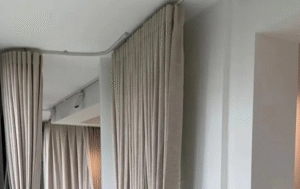
You’re looking at a detailed tender document for a new hotel project. It’s pages long, filled with requirements for load capacity, aluminum grades, and fire-retardant certifications. You feel confident your products meet every line item. But you have a nagging feeling that just checking these boxes misses the point. A year after installation, you get that dreaded call: curtains are getting stuck and gliders are popping out. The tracks met the written specifications, but they failed the real-world test, costing your client in maintenance and room downtime.
Hotel developers are asking for more than just compliance with basic technical specs. While tender documents list requirements for load-bearing capacity, fire safety, and material grades, the most experienced procurement teams now probe deeper. They ask about dynamic performance—how the track system withstands the "guest abuse factor." They know a track’s ability to resist off-axis yanking and maintain smooth operation is what truly determines its long-term value and minimizes the total cost of ownership for a hotel.
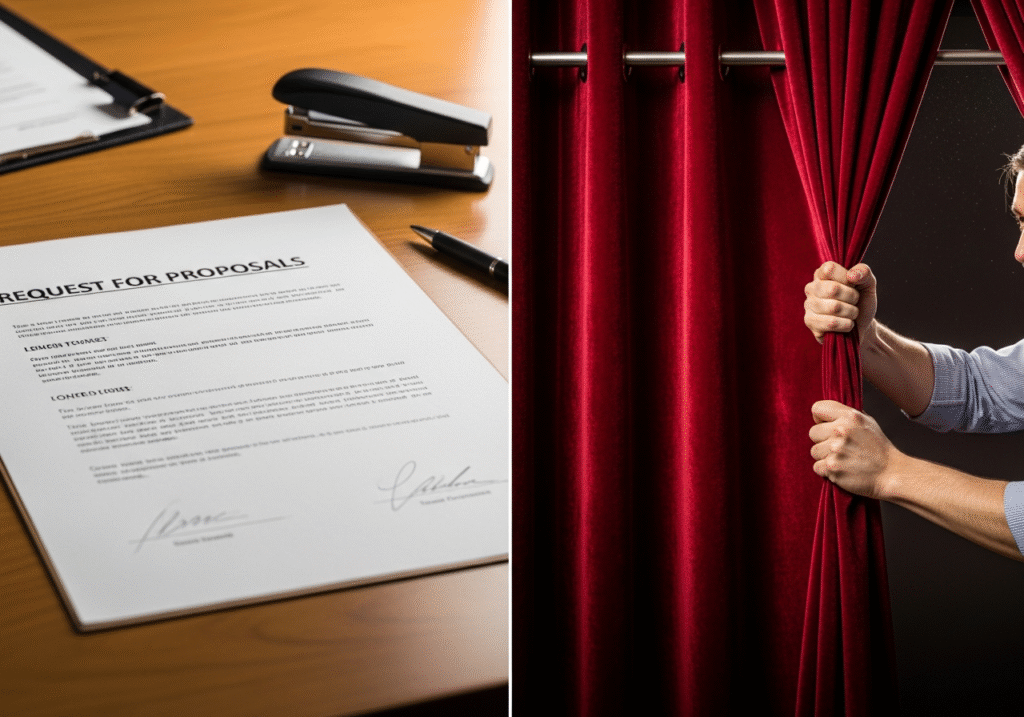
I learned this lesson the hard way early in my career. We supplied tracks for a luxury resort, and we won the bid because we met every technical specification perfectly. Six months later, I visited the property. I saw a housekeeper struggling with a curtain in one of the suites. The heavy blackout drape was stuck halfway. A guest had clearly yanked it from the bottom corner instead of pulling the wand. The shearing force had popped two gliders out of the channel. The room couldn’t be sold until maintenance fixed it. That day, I realized the numbers on the spec sheet don’t matter if the design can’t handle how real people use things. The questions on the tender are just the starting point.
What Technical Specs Do Hotel Developers Prioritize in Track Selection?
You’re comparing two curtain tracks. On paper, they look identical. Both are made from 6063-T5 aluminum and have the same weight per meter. One is slightly cheaper, so it seems like the logical choice. But you’ve been burned before by a product that looked good on the spec sheet but failed in practice. You know there must be something else beyond these basic numbers that determines real performance, but the tender document doesn’t ask for it.
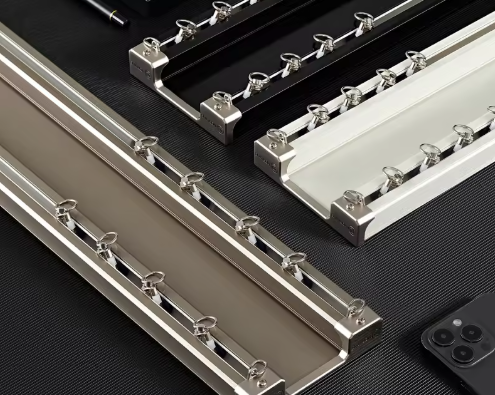
Today, developers prioritize the technical interaction between components, not just the isolated specs. They look for a system: a track profile designed for torsional rigidity combined with self-lubricating POM gliders that fit the channel with minimal friction. While aluminum grade and weight are still baseline requirements, the focus has shifted to the engineering of the complete system. This ensures a smooth, quiet glide that can withstand the daily, imperfect use it will face in a hotel room.
Beyond Aluminum Grade
The standard for quality tracks is 6063-T5 aluminum. It offers a great balance of strength, corrosion resistance, and a smooth surface for finishing. But the grade alone tells you nothing about the design. The real performance comes from the profile’s engineering. We focus on torsional rigidity—the track’s ability to resist twisting. When a guest yanks a curtain from the side, a weak track profile can twist slightly, causing the gliders to bind. A well-designed profile has internal reinforcement that prevents this.
Glider Design: The System’s Unsung Hero
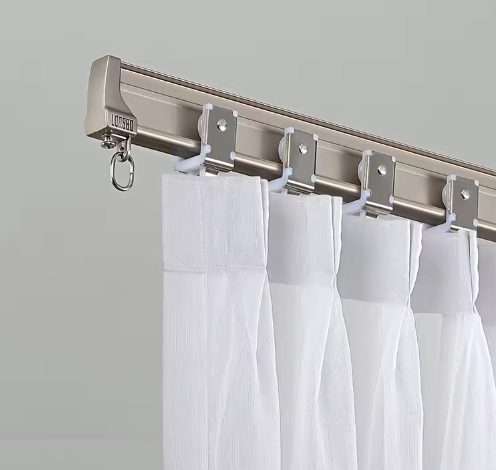
The glider, or carrier, is arguably the most important part of the system. A spec sheet might just say "plastic gliders." That’s not enough information. We use POM (polyoxymethylene), an engineering polymer that is incredibly durable and naturally self-lubricating. More importantly, we design the glider wheels to fit the internal race of our track profile perfectly. This ensures they roll smoothly with minimal friction, even when the curtain is being pulled from an odd angle.
The Finishing Touch
The final spec is the finish—typically powder coating or anodizing. Both provide a hard, durable surface. Powder coating offers a wider range of colors and a thick, protective layer. Anodizing chemically bonds with the aluminum, creating an extremely hard surface that won’t chip or peel. The choice depends on the project’s aesthetic and budget, but both are far superior to a simple spray-painted finish which will quickly wear away inside the track channel.
Technical Specs: What’s on Paper vs. What Matters
| Tender Specification | The Deeper Question to Ask |
|---|---|
| Material: 6063-T5 Aluminum | What is the track’s torsional rigidity to prevent twisting? |
| Gliders: Plastic Carriers | Are the gliders made from self-lubricating POM? |
| Weight: e.g., 400g/meter | How is the profile designed to support the glider channel? |
| Finish: Powder Coated | What is the thickness and hardness rating of the coating? |
How Do Fire-Safety and Compliance Standards Influence Tender Approval?
You’re finalizing a proposal for a large hotel project. You have all your product certifications ready, including the fire-safety ratings. But the developer’s procurement team is asking extra questions about which specific parts of the system are fire-retardant. You realize that just having a certificate for the main track isn’t enough. They are worried about every single component, from the plastic end caps to the glider wheels, and how they contribute to the building’s overall fire safety.
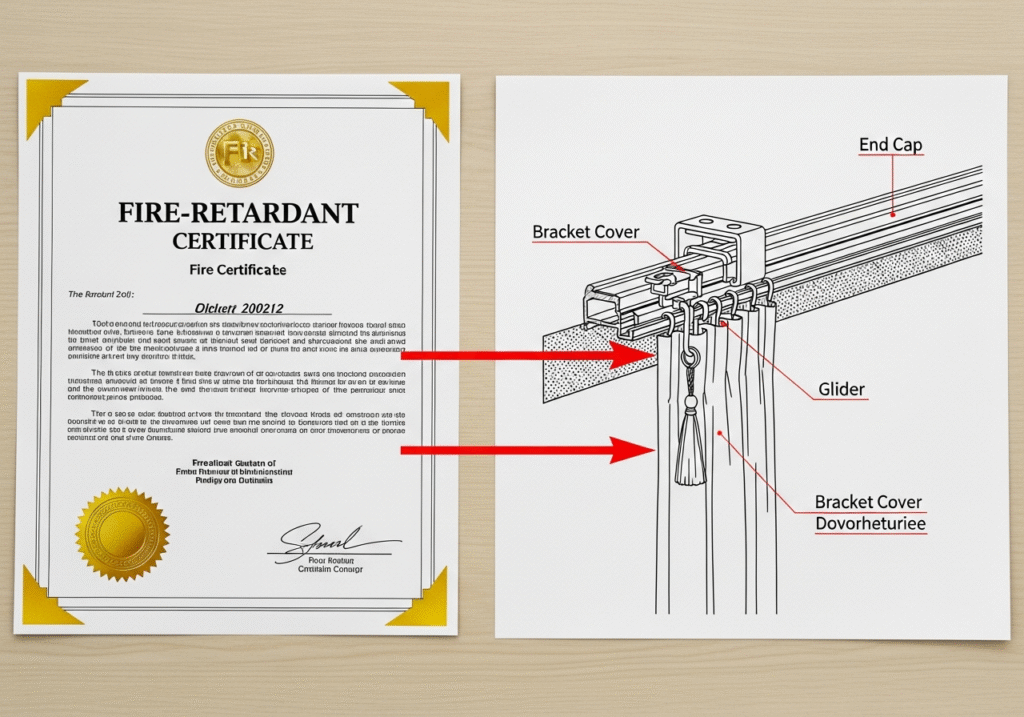
Fire-safety compliance is a non-negotiable, pass/fail criterion for tender approval. Developers require that all major components, not just the aluminum track, meet strict standards like NFPA 701 (in the US) or BS 5867 (in the UK). This includes plastic or polymer parts like gliders, end caps, and bracket covers. A manufacturer must provide clear documentation showing that the entire system, not just the track itself, is certified fire-retardant to be considered for a project.
It’s a System, Not Just a Track
A common mistake is to assume that because the aluminum track itself is not flammable, the system is compliant. However, in a fire, it’s often the plastic components that can create smoke or drip, contributing to the hazard. Experienced procurement managers know this. They will specifically ask for certifications for:
- Gliders/Carriers: These are the most numerous plastic parts in the system.
- End Caps & End Stops: These seal the track ends.
- Bracket Covers: If used, these plastic covers must also be compliant.
- Wands/Batons: Any plastic components on the draw rods must be certified.
Fire safety standards are not universal. A product certified in Asia may not be acceptable for a project in Europe or North America. A key capability for a global supplier is understanding these regional differences. We ensure our products are tested and certified according to the specific standards of the project’s location. This avoids costly delays and rejections during the approval process.
Documentation is Everything
You can’t just say your product is fire-retardant. You have to prove it. For any tender, we have a complete package of documents ready to go. This includes third-party lab test reports and certificates for every single component. Having this information organized and readily available shows a level of professionalism and preparedness that builds trust with the procurement team. It signals that we understand the seriousness of compliance and have done our due diligence.
Which Load-Bearing Requirements Matter for Heavy Drapery Systems?
Your client wants floor-to-ceiling blackout curtains in the presidential suite. The fabric is heavy, and the window is wide. The tender specifies a load capacity of "10 kg per meter." Your track meets that spec, but you’re still worried. You know that the total weight is just one part of the equation. A heavy curtain that is opened and closed thousands of times puts a different kind of stress on the system than a static weight just hanging there.
For heavy drapery, the most important requirement is the load capacity of the individual gliders and the spacing of the mounting brackets, not just the track’s static load rating. While the track must be strong enough, the system’s true strength lies in its weakest points. The gliders must handle the concentrated weight of the pleated fabric, and the brackets must be spaced closely enough to transfer that weight securely to the wall or ceiling without any sagging.
Static Load vs. Dynamic Load
A tender document often gives a static load rating (e.g., 10 kg/meter). This measures the weight the track can hold without bending when the curtain is still. But no hotel curtain is ever truly static. It’s constantly being opened and closed. This creates a dynamic load. As the curtain moves, the weight shifts, putting momentary stress on different parts of the system. This is why the carrying capacity of each individual glider is so important. A good heavy-duty glider might be rated to hold 1.5 kg on its own.
Bracket Spacing is Critical
A strong track is useless if it is not properly supported. For heavy, high-traffic curtains, the spacing of the mounting brackets is the most critical factor for success. Standard spacing might be 24 inches, but for a heavy system, we would recommend reducing that to 16 inches or even 12 inches. This distributes the load more evenly and prevents any possibility of the track sagging between the brackets over time. This is a detail we always clarify with project managers.
The Ripple Effect
In a ripplefold (or S-fold) curtain, the fabric is held at a fixed fullness. This means the gliders are always spaced evenly, and they move together as a unit. This is actually a very efficient system. However, for a traditional pinch-pleat curtain, the fabric can bunch up, putting the entire curtain’s weight on just a few gliders when it’s stacked open. This is where high-capacity gliders and robust end-stops are essential to prevent system failure.
Why Do Procurement Teams Compare OEM Capability and After-Sales Support?
You’ve submitted two bids. The first is from a simple trading company that offers a low price. The second is from an Original Equipment Manufacturer (OEM) like us, with our own factory. The OEM bid is slightly higher. The procurement manager, a smart guy named Matt, chooses the OEM bid. Why would he pay more? Because he isn’t just buying a product; he’s buying a partnership and insuring his project against future problems.
Procurement teams compare OEM capability because it provides a direct measure of a supplier’s quality control, customization potential, and long-term reliability. An OEM with in-house R&D, manufacturing, and quality control can guarantee consistency and offer tailored solutions. Strong after-sales support is equally critical, as it ensures that any issues, from shipping damage to installation questions, can be resolved quickly and directly by the people who made the product. This reduces risk for the developer.

The OEM Advantage: Control and Customization
Working with a true OEM offers several key advantages that a simple trader cannot match:
- Quality Control: At our factory, we control every step, from sourcing the raw aluminum to the final packaging. We can test for torsional rigidity, glider friction, and finish durability. A trading company is just buying from another factory, adding a margin, and has no real control over quality.
- Customization: What if a developer needs a track in a unique color to match the window frames? Or a specially designed bracket to navigate an awkward corner? As an OEM, we can design, tool, and produce custom components. A trader can only offer what’s in their catalog.
- Traceability: If an issue arises a year later, we have production records. We can trace the batch of aluminum used, the powder coating applied, and the quality reports for that specific order. This is impossible for a third-party seller.
After-Sales Support: The Real Test of a Partner
A low price is quickly forgotten when a problem occurs on-site and the supplier is unresponsive. This is where a manufacturer’s reputation is really made. Strong after-sales support means:
- Direct Communication: When an installer has a technical question, they can talk directly to our engineers, not a salesperson reading from a script.
- Fast Problem Resolution: If a box of tracks is damaged in transit, we can immediately produce and ship replacements from our own facility, minimizing project delays.
- Long-Term Accountability1: We stand behind our product for its entire lifecycle. We see ourselves as a partner in the project’s success2, not just a one-time supplier.
Conclusion
The questions on a tender document are important, but they are only the beginning of the conversation. Meeting specs for load, fire safety, and materials is the minimum requirement to be considered. The suppliers who win the best projects are the ones who can answer the deeper questions. They can prove how their products stand up to the dynamic stress of real-world use, and they can demonstrate that they have the manufacturing control and support systems in place to be a reliable partner, not just a vendor. That is where true value and long-term performance are found.
Of course. Here are 10 relevant FAQs and a meta description based on the article you provided.
Frequently Asked Questions (FAQ)
1. What is the "guest abuse factor" and why is it important for hotel curtain tracks?
The "guest abuse factor" refers to the tendency of hotel guests to operate curtains improperly, such as yanking them from the side or bottom instead of using the wand. This creates off-axis, dynamic stress. It’s important because a track system that can withstand this abuse will have fewer failures, reducing maintenance costs and preventing room downtime.
2. My tender only asks for aluminum grade. How can I specify a track with better torsional rigidity?
You can add a line to your tender asking suppliers to provide data on the track’s torsional resistance or deflection under an off-axis load. Alternatively, ask for a detailed cross-section diagram of the profile to see its internal reinforcement, and request a physical sample to test its rigidity yourself.
3. Aren’t all plastic gliders basically the same?
No, there is a huge difference. High-quality gliders are made from engineering polymers like POM (polyoxymethylene), which is self-lubricating and extremely durable. Cheaper gliders made from standard polypropylene (PP) or polyethylene (PE) will wear out quickly, become brittle, and cause the curtain to snag.
4. If a track system is certified fire-retardant, does that cover all components?
Not necessarily. You must verify that the certification explicitly covers all non-metallic parts, including the gliders, end caps, and any plastic bracket covers or wand components. A reputable manufacturer will provide a full documentation package with test reports for each individual component.
5. For a heavy curtain, is it better to use a heavier track or more brackets?
Both are important, but adding more brackets is often the more critical factor. A standard heavy-duty track can handle significant weight, but it must be properly supported to prevent sagging. Reducing bracket spacing from a standard 24 inches to 16 or 12 inches is the best way to ensure long-term stability for heavy drapery.
6. What is the difference between an OEM and a trading company supplier?
An OEM (Original Equipment Manufacturer) designs and manufactures the products in their own factory, giving them full control over quality, materials, and customization. A trading company simply buys products from various factories and resells them, offering less control, limited technical support, and little to no customization capability.
7. How can I test a supplier’s after-sales support before I award the contract?
During the vetting process, ask detailed technical questions about installation or hypothetical problems. Note the speed, accuracy, and professionalism of their response. Ask for references from similar-sized projects and contact them specifically about their experience with the supplier’s support when issues arose.
8. What does "dynamic load" mean for a curtain track?
Dynamic load refers to the forces placed on the track while the curtain is in motion. This includes the momentum of the moving fabric and the stress from being pulled, especially from an angle. It is a more realistic test of performance than a "static load," which just measures how much weight the track can hold when the curtain is stationary.
9. Can a good glider design really prevent the track from feeling "stuck"?
Yes, absolutely. A well-designed glider that fits the track channel precisely with minimal friction is the key to a smooth glide. When combined with a torsionally rigid track, it ensures the gliders can roll freely even when the curtain is pulled imperfectly, preventing the binding and snagging that makes a track feel stuck.
10. Is an anodized or powder-coated finish better for a hotel track?
Both are excellent, durable finishes. Anodizing creates an exceptionally hard, integrated surface that is nearly impossible to chip and is great for high-wear environments. Powder coating provides a thick, protective layer and offers a much wider range of custom colors to match hotel decor. The choice often depends on aesthetic priorities and budget.