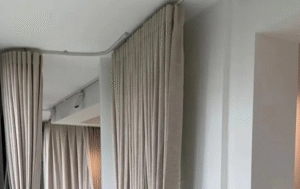
You’re walking the floor of a new hotel project. In every other room, an installer is wrestling with a long piece of aluminum track, a tape measure, and a chop saw. You see the pile of mis-cuts and wasted material in the corner, and the fine layer of aluminum dust settling on the new carpets. You’re paying for every minute they spend measuring, marking, and cutting—time they aren’t actually installing. It feels inefficient, messy, and expensive, because it is.
The single best way to measure and cut tracks for a large-scale hotel installation is to eliminate the task from the job site entirely. The most cost-effective and precise method is to provide the manufacturer with a detailed "cut list" based on the architectural plans. The factory then uses automated saws for perfect, repeatable cuts. The tracks arrive on-site pre-sized, labeled by room number, and ready for immediate installation, transforming a manual task into a simple, logistical process.
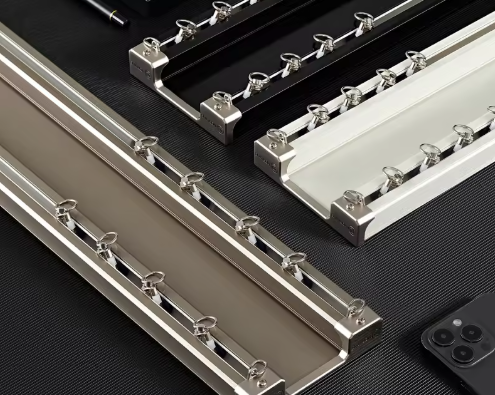
I’ll never forget a project we supplied in Dubai. It was a 500-room luxury hotel, and the contractor insisted his team would cut the tracks on-site. I went to visit during the installation phase. It was chaos. The noise was constant, and fine metallic dust was everywhere, despite the brand-new air purifiers a ainst the wall. I saw an installer measure a track, cut it, then hold it up to the window only to realize he had cut it an inch too short. The entire 5-meter piece was now scrap. That single mistake didn’t just cost the price of the aluminum; it cost labor, created delays, and added to the project’s waste. It proved to me that the real skill isn’t in cutting a track; it’s in creating a system where you never have to.
What Tools Do You Need to Measure Hotel Window Frames Accurately?
Your installation team is on a tight schedule. They’re using standard tape measures to size each window frame, but you notice inconsistencies. One installer rounds up, another rounds down. Small variations from room to room are causing big headaches, leading to gaps or tracks that are too tight. You’re dealing with rework and delays, all stemming from the simple act of measuring. The inconsistency is undermining your entire project’s timeline and budget.
For accurate on-site measurements, a high-quality laser distance measurer is the essential tool, far superior to a traditional tape measure. It eliminates errors from tape sag or misreading and provides instant, precise readings. However, for a large-scale hotel project, the most critical "tool" isn’t on-site at all. It is the master set of architectural drawings, which serves as the single source of truth for creating a definitive ‘cut list’ for the manufacturer, ensuring uniformity across the entire project.
The Problem with On-Site Measuring
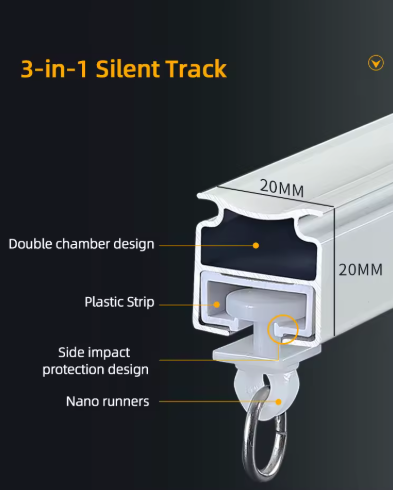
Even with the best laser measure, on-site measuring for a high-volume project is fundamentally flawed.
- Human Error: A reading of ‘255.4 cm’ can easily be written down as ‘254.5 cm’. This single error results in a wasted track.
- Structural Inconsistencies: The window frame in room 301 might be a quarter-inch wider than in room 401 due to minor variations in construction. If you cut every track based on one room’s measurement, you create problems down the line.
- It’s Inefficient: The time spent measuring hundreds of windows is significant paid labor that could be eliminated.
The Power of a Master "Cut List"
The modern, efficient method bypasses on-site measuring completely. We work from the architectural plans to create a spreadsheet—a master cut list. This document lists every single track for the project: Room 301, Window 1, Type A, Length 255.0 cm. This becomes the bible for the project. At the factory, we feed this list into our automated cutting machines. Every single piece is perfect.
On-Site Measuring vs. Factory Cut List
| Feature | On-Site Manual Measuring | Factory Cut List |
|---|---|---|
| Accuracy | Prone to human error & inconsistency. | Perfect, machine-controlled precision. |
| Speed | Extremely slow; adds hours of labor. | Fast; tracks arrive ready to install. |
| Waste | High due to mis-cuts and errors. | Near-zero material waste. |
| Cleanliness | Creates messy aluminum dust on-site. | Clean; all cutting is done in the factory. |
How Do You Determine the Correct Track Length for Oversized Hotel Windows?
You’re outfitting a conference room with a 40-foot wall of glass. Your standard 19-foot track extrusions aren’t long enough. The default plan is to join two or more pieces together on-site. But you know that every seam, or "splice," is a potential failure point. It’s a place where the curtain carriers can snag and get stuck, leading to maintenance calls and unhappy clients. A spliced track on a feature window looks unprofessional and compromises function.
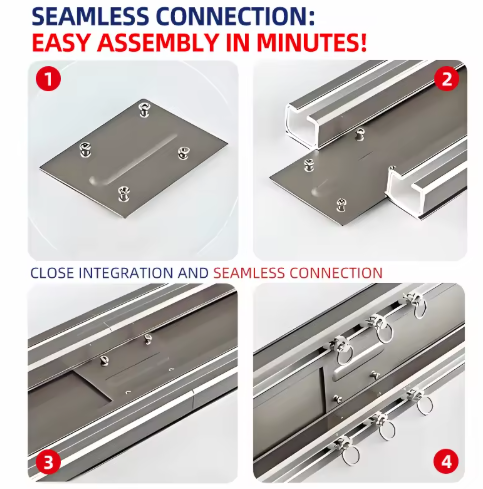
For oversized windows, the correct track length is a single, continuous piece, cut to the exact specified dimension. Splicing smaller tracks together on-site should be avoided at all costs. Modern manufacturers can extrude and ship single tracks well over 20 or 30 feet long. The correct process is to specify the exact, final wall-to-wall dimension on the factory cut list, ensuring a seamless, smooth-gliding system with no joints to snag or fail.
The Dangers of Splicing Tracks
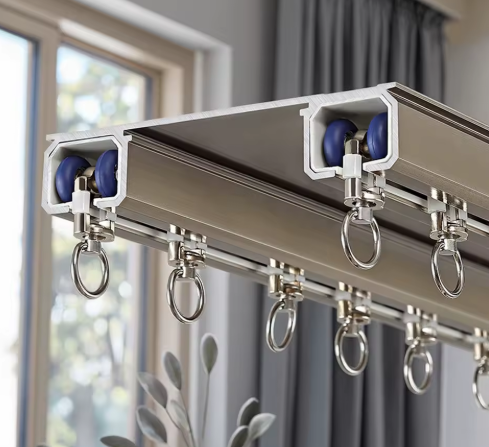
Splicing is the practice of joining two track sections with a small internal connector. While sometimes unavoidable for truly massive spans, it should never be the default solution.
- Carrier Snagging: No matter how well it’s done, a seam creates a tiny bump. Over thousands of open-and-close cycles, this is where carriers will eventually catch, frustrating guests.
- Weak Point: The joint is a structural weak point. Over time, a heavy curtain can cause the track to sag slightly at the splice point, worsening the snagging problem.
- Visual Imperfection: On a high-end project, a visible seam in the middle of a beautiful curtain track looks like a shortcut. It detracts from the clean, high-end finish.
Specify, Don’t Splice
The professional solution is simple. The architectural plans will show the wall-to-wall dimension. We take that number and manufacture a single, continuous piece of aluminum to that exact length. It costs a little more to ship a 30-foot-long item, but that cost is tiny compared to the long-term labor and maintenance costs of a failing, spliced system. For a luxury finish, a seamless track is non-negotiable.
What Cutting Techniques Prevent Track Bending or Deformation?
The installer is using a standard hacksaw to cut a piece of track to size. The cut is rough, with a jagged burr on the edge. This tiny piece of metal is enough to shred the first curtain carrier that passes over it. In the next room, another installer uses a power saw with the wrong blade, and the heat from the friction slightly deforms the track’s channel. Now, the carriers get stuck. These small details in the cutting process are creating massive long-term functional problems.
To prevent bending or deformation, the only acceptable cutting technique involves a high-speed chop saw equipped with a carbide-tipped blade specifically designed for non-ferrous metals like aluminum. The track must be securely clamped in a jig during the cut to prevent any movement. After the cut, the edge must be de-burred with a fine file for a perfectly smooth finish. This precision is standard in a factory setting but difficult and time-consuming to replicate on a busy construction site.
The Right Tool for the Job
Cutting aluminum correctly requires specific equipment.
- The Blade: A standard wood or steel blade will tear at aluminum. You need a blade with a high tooth count and a negative hook angle. This shaves the metal cleanly instead of grabbing it.
- The Saw: A high-RPM chop saw ensures a fast, cool cut. Too much friction generates heat, which can warp the thin walls of the track profile.
- The Jig: The track profile is complex. It must be held securely in a custom jig or clamp that supports its shape during the cut. Just resting it on the saw base is how deformation happens.
De-burring: The Most Skipped Step
After the cut, the inside edge of the track will have a tiny, sharp lip of metal called a burr. On-site, busy installers often skip the step of filing this down. But this burr acts like a tiny knife. As the curtain is pulled, it can slice into the plastic wheels of the carriers, destroying them over time and causing the entire system to fail. In our factory, every single cut piece goes through a quality check where it is de-burred by hand. This five-second step is crucial for long-term performance.
How Can Installers Ensure Perfect Alignment During Large-Scale Hotel Installations?
You walk down a newly finished hotel corridor and look at the curtain tracks. Some are an inch from the ceiling, others are an inch and a half. The inconsistencies are subtle, but they’re there. In a project where uniformity is key to a high-end feel, these small misalignments look sloppy and unprofessional. Achieving perfect, repeatable alignment across hundreds of rooms with manual methods is nearly impossible.
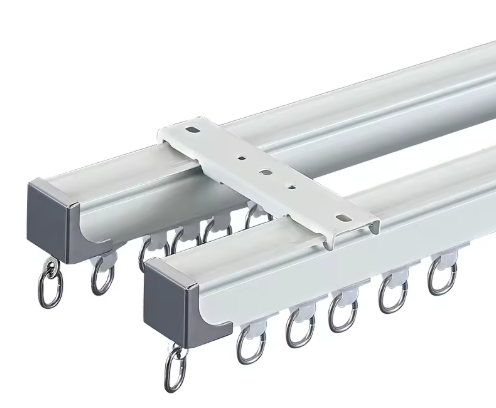
Perfect alignment across a large-scale installation is achieved by using a laser level as a guide for every single room and by pre-assembling components at the factory. The laser provides a perfectly consistent horizontal line for bracket height. Furthermore, having brackets pre-attached to the tracks at the factory ensures that the spacing between brackets is identical an every single track. This combination of laser guidance and pre-assembly removes guesswork and guarantees uniformity.
The Laser Level: The Only Source of Truth
A tape measure and a pencil are not accurate enough for this job.
- Establishing a Benchmark: An installer should use a laser level to establish a single, consistent height from the ceiling or floor for the entire floor of the hotel. This red line is the guide for the top of every bracket.
- Eliminating Creep: When measuring down from the ceiling in each room, tiny variations in ceiling height can cause the track height to "creep" up or down from room to room. A laser a ainst the wall eliminates this problem entirely.
Pre-Assembly: Removing On-Site Variables
Even with a level line, if installers are attaching brackets to the track themselves, the spacing between brackets will vary.
- Factory Precision: We can pre-assemble the brackets onto the tracks in our factory. We use jigs to ensure the spacing is identical—for example, exactly 4 inches from each end and 16 inches on center.
- Reduced Labor1: This also saves an enormous amount of time on-site. The installer isn’t fumbling with tiny screws and brackets. They simply take the pre-assembled unit, align it with the laser line, and drill it into the wall. Installation time2 per window can be cut by more than half.
Conclusion
The core lesson is this: the most significant gains in efficiency, quality, and cost-savings for hotel curtain track installations do not come from working harder on-site, but from working smarter with your supply chain partner. By shifting tasks like measuring, cutting, and pre-assembly back to the controlled factory environment, you eliminate the biggest sources of error, waste, and delay. The next time you’re planning a large project, don’t ask your installers how they plan to cut the tracks. Instead, ask your manufacturer how they can deliver a product that makes on-site cutting completely obsolete.
Frequently Asked questions (FAQ)
1. Is it really more cost-effective to order pre-cut tracks when my installers are paid by the hour anyway?
Absolutely. While there might be a small premium for the factory cutting service, you save far more on labor costs. Installation time per room is drastically reduced, you eliminate material waste from mis-cuts (which can be a significant cost), and you avoid costly delays caused by on-site errors.
2. What if the architectural plans are wrong or change? Aren’t on-site measurements safer?
This is why a final field measurement check is still important for a single "typical" room. If a discrepancy is found between the plans and the built reality, the cut list can be adjusted before mass production begins. This "measure once, cut 500 times" approach is far safer than manually measuring 500 different times.
3. How much material waste is realistically saved by using a factory cut list?
On large projects, on-site cutting can result in a material waste factor of 5-10% from mis-cuts, off-cuts, and errors. With a factory cut list, the waste is nearly zero, as automated software optimizes how the lengths are cut from raw extrusions. You only pay for the product you use.
4. What kind of lead time is needed for a factory-prepared cut list order?
The lead time is typically not much longer than a standard bulk order. The key is to provide the cut list to the manufacturer early in the project timeline, ideally as soon as the window and wall dimensions are finalized. This planning allows the cutting to be integrated seamlessly into the production schedule.
5. How are the pre-cut tracks packaged and labeled for a large project?
Each track is individually wrapped to prevent scratching, then bundled and labeled by room number, floor, or building section, according to the project’s needs. For example, a package might contain all the tracks for rooms 301-310. This makes on-site distribution simple and error-free.
6. Won’t shipping extremely long, single-piece tracks for oversized windows be very expensive?
While there are additional freight costs for oversized items, this expense is a planned, one-time cost. It is almost always less than the long-term, unpredictable costs of dealing with a failed or snagging spliced track, which includes maintenance labor, guest complaints, and potential damage to the curtains.
7. My installers are skilled craftsmen who take pride in fitting things perfectly on-site. Will they resist this method?
The most skilled installers appreciate a system that lets them work faster and produce a better result. Frame it as a way to enhance their skill: instead of spending their time making messy cuts, they can focus on perfect, high-speed installation and alignment, increasing their overall productivity and the quality of their work.
8. What happens if a few tracks arrive damaged from shipping?
A reputable manufacturer will have a clear process for this. Because the project is based on a master cut list, a replacement for "Room 412, Window B" can be quickly produced and expedited to the job site, minimizing any potential delays.
9. Can you pre-attach other components besides brackets at the factory?
Yes. For motorized tracks, the motor and master carriers can often be pre-installed and tested at the factory. This turns a complex on-site assembly into a simple "plug-and-play" installation, further reducing labor time and the chance of errors.
10. How does eliminating on-site cutting affect site cleanliness and safety?
It has a huge positive impact. You eliminate airborne aluminum dust, which can be a respiratory hazard and create a mess that requires extensive cleanup. You also remove noisy chop saws from the site, making the environment safer and quieter for all trades working in the building.