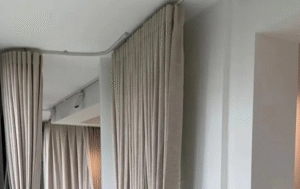
Are you specifying curtain tracks for a project in a coastal or humid region, worried about rust and corrosion? You might assume a coated track is the obvious choice for longevity, only to get a complaint months later about the finish bubbling and peeling. The visible oxidation on an uncoated track seems like a clear problem, but the real enemy is hidden. A sudden, catastrophic coating failure is far worse than predictable aging. Understanding what truly protects a track in humidity is key to avoiding costly mistakes.
In humid climates, eco-coated tracks offer superior longevity, but only if the subsurface preparation is flawless. The real threat isn’t surface rust but filiform corrosion, where moisture seeps under the coating and causes it to delaminate and fail suddenly. An uncoated track will oxidize predictably into a stable, dull finish. In contrast, a poorly applied coating hides this creeping damage until it’s too late. The longevity of a coated track depends entirely on the invisible pretreatment that bonds the finish to the metal.

I’ll never forget a beachfront hotel project from years ago. The specifier insisted on a premium "marine-grade" powder-coated track. It looked fantastic on installation day. Less than a year later, I got a call. The finish was peeling off in sheets. The client blamed the coating, but I knew the truth was deeper. The supplier had skipped the critical chemical pretreatment step to save a few cents. Moisture got under the paint, and the bond failed. That day taught me a vital lesson: the name of the coating means nothing. The invisible science behind how it’s applied is everything. It’s what prevents a beautiful finish from becoming a costly failure.
How do different materials and coatings—eco-coated aluminum, anodized finishes, or powder coatings—resist corrosion in humid or coastal environments?
You’re reviewing supplier options for a coastal hotel, and the choices are overwhelming: anodized, powder-coated, "eco-friendly." Each claims to be the best. The fear is choosing a finish that looks great in the catalog but fails within a year of being exposed to salty air, leading to angry clients and damage to your reputation. How can you confidently choose the right protection when every option sounds good on paper? The key is to understand how each one actually fights corrosion at a microscopic level.
Different coatings resist humidity in distinct ways. Anodized finishes create an integrated, ultra-hard layer of aluminum oxide that cannot peel, offering excellent corrosion resistance. Powder coatings provide a thick, durable plastic barrier but are vulnerable if chipped. Eco-coatings offer a sustainable balance, but like all coatings, their effectiveness hinges on the pretreatment. It’s this initial bonding process that prevents moisture from getting underneath and causing catastrophic delamination—the ultimate failure point in humid environments.

Anodized Finishes: The Integrated Barrier
Think of anodizing not as a coating, but as a controlled transformation of the aluminum itself. We use an electrochemical process to grow a layer of aluminum oxide—one of the hardest natural substances—directly from the base metal. This layer is fully integrated and can’t flake, peel, or blister. For coastal environments, this is a huge advantage. Its only weakness is that the color palette is more limited, and it can be susceptible to harsh chemical cleaners.
Powder Coating: The Thick Defense
Powder coating involves spraying a dry, electrostatically charged powder onto the track, then baking it in an oven. This melts the powder into a thick, uniform, and very durable plastic shell. It offers a huge range of colors and textures and is excellent at resisting scratches and impacts. However, its strength is also its weakness. If the coating is chipped or deeply scratched, moisture can penetrate the opening and travel underneath the finish, causing the dreaded filiform corrosion.
Eco-Coatings: The Modern Balance
"Eco-coating" is a broad term, but it generally refers to modern, water-based or low-VOC (Volatile Organic Compound) liquid paints. Their performance has improved dramatically and can rival traditional powder coatings. Their true advantage lies in the advanced pretreatment processes they are paired with. Modern, chromate-free chemical conversion coatings create a microscopic surface that the eco-coat can bond to with incredible strength. This superior bond is the best defense against subsurface moisture intrusion.
| Feature | Anodized Finish | Powder Coating | Eco-Coating |
|---|---|---|---|
| Corrosion Resistance | Excellent; integrated layer doesn’t peel. | Very Good; but vulnerable if chipped. | Excellent; when paired with proper pretreatment. |
| Durability (Scratch/Chip) | Good; but can be scratched by sharp objects. | Excellent; very tough and impact-resistant. | Good to Very Good; depends on formulation. |
| Appearance | Metallic sheen, limited colors. | Wide range of colors and textures. | Wide range of colors, smooth finish. |
| Eco-Friendliness | Moderate; process uses acids. | Good; no solvents, but baked at high energy. | Excellent; often water-based with low VOCs. |
From a lifecycle perspective, do uncoated tracks degrade faster, and how does maintenance frequency compare between coated and uncoated options?
Many purchasing managers automatically dismiss raw, uncoated aluminum tracks. The assumption is that "uncoated" equals "low quality" and will mean constant maintenance headaches for the end-user. This can lead you to specify a more expensive coated option, thinking you’re buying peace of mind. But what if that coated track, vulnerable to hidden failure, is actually the riskier choice? It’s time to reconsider the true lifecycle and maintenance reality of an uncoated track.
From a visual perspective, uncoated tracks degrade faster by oxidizing into a dull, chalky patina. However, this oxide layer is non-progressive and actually protects the underlying aluminum from further corrosion. Its maintenance is simple: periodic cleaning to remove dirt. A coated track requires more vigilant inspection for chips and scratches, which must be touched up to prevent water intrusion. In the long run, the predictable aging of an uncoated track can be less maintenance-intensive than preventing catastrophic failure on a coated one.

The Predictable Aging of Uncoated Aluminum
When bare aluminum is exposed to air and moisture, it instantly forms a thin, tough, and transparent layer of aluminum oxide. In a humid or coastal environment, this layer becomes thicker and turns into the familiar chalky, dull gray patina. While some may not like this aesthetic, the process is self-limiting. Once the protective patina is formed, the corrosion effectively stops. The track’s structural integrity is not compromised. It ages gracefully and predictably.
Lifecycle of a Coated Track
A coated track begins its life looking perfect. Its lifecycle is entirely dependent on maintaining that perfection. Every scratch, chip, or installation scuff is a potential entry point for moisture. In a high-humidity environment, this isn’t a matter of "if" but "when." The risk is that the corrosion happens out of sight, under the paint. By the time you see a bubble, the damage is already widespread. An uncoated track shows you its condition honestly; a coated track can hide a serious problem.
Comparing Maintenance Demands
The maintenance approach for each is fundamentally different. An uncoated track asks for cleaning, while a coated track demands inspection.
- Uncoated Track Maintenance: Wipe down with a soft cloth and mild, non-abrasive detergent a few times a year to remove salt and grime buildup from the patina. That’s it.
- Coated Track Maintenance: Requires regular visual inspection, especially at the ends, joints, and around bracket points. Any breaches in the coating must be immediately sealed with a touch-up pen to prevent moisture from creeping underneath. This is a more detail-oriented and critical task.
| Aspect | Uncoated Aluminum Track | Coated Aluminum Track |
|---|---|---|
| Degradation Type | Slow, visible surface oxidation (patina). | Sudden, hidden subsurface delamination. |
| Visual Aging | Predictable change from shiny to dull gray. | Stays perfect until it suddenly blisters/peels. |
| Maintenance Action | Periodic cleaning. | Vigilant inspection and touch-up. |
| Failure Mode | Gradual aesthetic change. | Catastrophic coating failure. |
Can eco-coated finishes serve as a key selling point for sustainability-minded importers or project specifiers?
Your client, a specifier for a new chain of boutique hotels, is under pressure to achieve a green building certification. They’re scrutinizing every material, from the carpets to the curtain tracks. You offer them a standard powder-coated option, but your competitor leads with an "eco-coated" track and a story about sustainability. Suddenly, your product seems dated, and you’re on the defensive. Can a simple coating choice really become a powerful selling point?
Absolutely. Eco-coated finishes are a powerful selling point for sustainability-minded importers and specifiers. The key is to market them not just as a "green" product, but as a "smarter" product. Highlighting benefits like low-VOC content, reduced energy consumption during manufacturing, and compliance with certifications like LEED or BREEAM directly addresses their needs. By framing the eco-coating as a feature that offers equal or better performance while helping them meet their environmental goals, you turn a technical detail into a competitive advantage.

Speaking the Language of Green Building
Sustainability-minded clients think in terms of specific criteria and certifications. When presenting an eco-coated track, you need to connect your product’s features to their goals.
- Low VOCs (Volatile Organic Compounds): This is a critical factor for indoor air quality, a major component of standards like LEED (Leadership in Energy and Environmental Design) and WELL. Frame it as "contributing to a healthier indoor environment for guests and staff."
- Energy-Efficient Curing: Many modern eco-coatings cure at lower temperatures than traditional powder coatings, reducing the energy footprint of manufacturing. This is a powerful story about responsible production that resonates with eco-conscious brands.
Performance Does Not Take a Backseat
A common fear is that "eco-friendly" means "lower performance." It is essential to counter this perception head-on. You must emphasize that your eco-coated tracks meet or exceed the performance benchmarks of traditional coatings. Provide the technical data: results from salt spray tests (ASTM B117), adhesion tests, and humidity resistance tests. The message should be clear: "You are not making a compromise. You are getting advanced, sustainable technology without sacrificing durability."
The Complete Sustainability Package
To make the eco-coating a truly compelling selling point, build a narrative around it. This includes the track’s base material—aluminum, which is highly recyclable—and your company’s responsible manufacturing practices. Show them the whole picture:
- High Recycled Content: Emphasize the percentage of recycled aluminum used in your extrusions.
- Water-Based Pretreatment: Highlight the use of chromate-free conversion coatings, which are far less toxic than older methods.
- End-of-Life Recyclability: Remind them that the entire track assembly can be fully recycled at the end of its long life.
| Feature of Eco-Coating | Selling Point for Specifier | How to Frame It |
|---|---|---|
| Low-VOC Formulation | Meets indoor air quality standards (LEED). | "A healthier choice for indoor spaces." |
| Lower Curing Temperature | Reduced manufacturing energy consumption. | "Responsibly manufactured to lower your project’s carbon footprint." |
| Chromate-Free Pretreatment | Reduced toxic chemical usage. | "A safer product from a forward-thinking supplier." |
| High Performance | No compromise on durability. | "Sustainable innovation without sacrificing quality." |
What long-term maintenance steps—such as lubrication, bracket inspection, or slider replacement—extend track lifespan in high-humidity regions?
You’ve supplied the perfect corrosion-resistant tracks for a seaside resort. The installation is flawless. A year goes by, and everything seems fine. Then, a call comes in: the curtains are becoming difficult to pull. The client thinks the track is failing. But the real issue isn’t corrosion; it’s the accumulation of salt and grime inside the channel, combined with dried-out gliders. Without a clear maintenance plan, even the best track will seem to fail, leading to unnecessary service calls and client dissatisfaction.
To extend a track’s lifespan in high-humidity regions, a simple, proactive maintenance plan is crucial. This involves periodic channel cleaning to remove salt and grit, lubrication with a dry silicone spray, and regular bracket inspection to check for any loosening. Glider replacement every few years can also restore a like-new, smooth operation. These simple steps prevent the most common performance issues and ensure the track operates flawlessly for decades, regardless of the climate.

Cleaning: The Most Important Step
In coastal areas, the air is full of fine salt particles and moisture. This mixture settles inside the curtain track channel, creating a gritty, abrasive paste. As gliders move across this paste, it causes friction and wear. The single most effective maintenance task is cleaning this channel out. At least twice a year, the channel should be wiped with a soft cloth dampened with freshwater, followed by a dry cloth. A vacuum with a crevice tool is also excellent for removing loose debris.
Lubrication: Use the Right Product
After cleaning, lubrication is key. However, using the wrong product can make things worse. Oily lubricants like WD-40 or grease will attract and trap even more dust, salt, and grime, creating a sticky mess that gums up the gliders. The only correct choice is a dry silicone spray. This type of lubricant deposits a slick, microscopic layer of silicone that is dry to the touch. It repels moisture and provides excellent lubrication without attracting dirt.
Hardware Inspection: Brackets and Gliders
Humidity and temperature fluctuations can cause hardware to loosen over time. As part of a biannual maintenance routine, every bracket screw should be checked for tightness. This prevents track sag and ensures the system remains secure. At the same time, it’s a good idea to inspect the gliders (or sliders). Over years of use, they can become brittle or worn. Replacing the gliders is an inexpensive fix that can make an old track feel brand new.
| Maintenance Task | Frequency | Why It’s Critical in Humid Climates | Recommended Product/Tool |
|---|---|---|---|
| Channel Cleaning | 2-4 times per year. | Removes abrasive salt and grime buildup. | Microfiber cloth, vacuum with crevice tool. |
| Dry Lubrication | 1-2 times per year (after cleaning). | Reduces friction without attracting dirt. | Dry silicone spray only. |
| Bracket Inspection1 | 1-2 times per year. | Prevents track sag from loosened screws. | Screwdriver or appropriate drill bit. |
| Glider Replacement2 | Every 5-7 years, or as needed. | Restores smooth, effortless curtain operation. | OEM replacement gliders. |
Conclusion
Choosing the right curtain track for a humid climate goes far beyond simply picking a "coated" option. True longevity lies in understanding the science of corrosion and adhesion. While an uncoated track offers predictable performance, a high-quality eco-coated track, applied with meticulous pretreatment, provides superior protection against the hidden threat of delamination. By communicating these technical benefits, you can position eco-coatings as a key selling point for sustainable projects. Finally, empowering clients with a simple, effective maintenance plan ensures the track system delivers smooth, reliable performance for its entire lifecycle, solidifying your reputation as an expert partner.