You’re managing a rollout for a 20-hotel chain, and you just got two quotes. Quote A has a per-meter track price that’s 20% lower than Quote B. It feels like an obvious win. But when the shipment arrives, each box is a sea of loose parts: multi-piece brackets, bags of screws, and endless carriers. Your installation team’s efficiency plummets as they spend hours on tedious assembly for every single window. The labor costs are spiraling out of control, completely erasing your initial savings and threatening the project timeline.
The smartest way to manage curtain track procurement for multi-hotel chains is to shift focus from the per-meter price of aluminum to the total installed cost per room. This means prioritizing complete, pre-assembled systems where brackets are single-piece and carriers are pre-loaded. While the initial unit price may be slightly higher, the dramatic reduction in on-site labor costs, minimized installation errors, and faster project completion deliver far greater savings when scaled across hundreds or thousands of rooms.
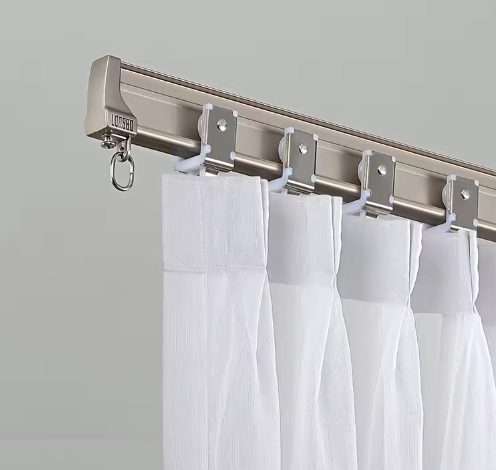
I’ll never forget a project in Dubai for a massive 800-room hotel. The procurement manager was brilliant but obsessed with the raw aluminum cost. He negotiated us down to a rock-bottom price per meter. To meet his price, we had to ship the most basic, multi-part components. Two weeks into the installation, I got a frantic call. His teams were spending over an hour per window just assembling the brackets. The entire project was grinding to a halt. We ended up air-freighting our pre-assembled bracket systems at a huge cost to get them back on schedule. That taught me a powerful lesson: we don’t just sell tracks; we sell installation efficiency. A few dollars saved on materials can cost a hundred dollars in wasted labor.
What Specifications Really Matter When Sourcing Curtain Tracks for Hotel Projects?
You receive a spec sheet for a curtain track. It details the aluminum alloy, the profile dimensions, and the powder-coating thickness. Everything looks robust and high-quality. You approve the order, confident in your choice. But the installation feedback is a disaster. The brackets require complex assembly, the carriers keep falling out during installation, and the end-stops are flimsy. You specified a strong track, but you overlooked the specifications for the system’s efficiency, creating a bottleneck that costs time and money.
When sourcing for large hotel projects, the most critical specifications are not just the track’s material, but the system’s design for installation speed. Prioritize single-piece, heavy-gauge steel brackets, factory-loaded carriers that stay in the track, and robust end-stops. These "system" specifications have a much larger impact on the total project cost than the aluminum profile itself, as they directly reduce the most expensive variable: on-site labor time.
Beyond the Aluminum Profile
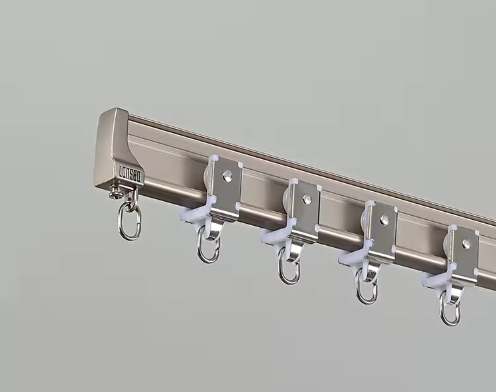
While a high-quality aluminum track is the foundation, it’s a given from any reputable manufacturer. The real difference is in the components that attach to it. A spec sheet should go beyond the track and detail every part of the system.
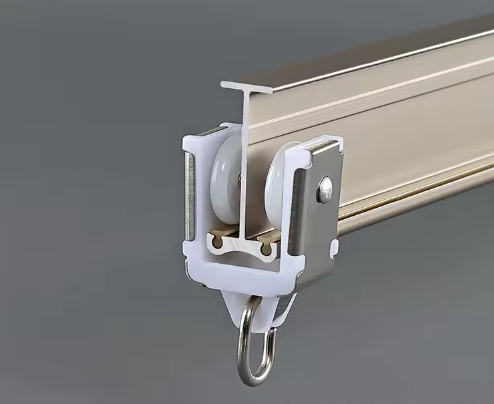
- Bracket Construction: Is it a single piece of stamped, heavy-gauge steel, or is it a flimsy, three-part assembly held together with tiny screws? A single-piece bracket is stronger and installs in a fraction of the time.
- Carrier Design: Are the carriers pre-loaded into the track at the factory? Do they have a retention clip to prevent them from falling out before the end-stop is fitted? This small detail saves immense frustration and time on site.
- End-Stop Durability: Is the end-stop a robust piece of metal or POM that can handle the shock of a curtain being yanked, or is it a cheap piece of plastic that will crack on the first hard pull?
The Power of a Complete System
Smart procurement means buying a complete, engineered system, not a collection of parts. When the track, carriers, brackets, and end-stops are designed to work together, everything fits perfectly. This eliminates the guesswork for installers and ensures a consistent, high-quality result in every room. A factory that thinks in terms of systems will always deliver a more efficient product than one that just sells extruded aluminum.
Sourcing Approach Comparison
The focus of your sourcing questions determines the value you receive. Shifting from components to systems is key.
| Sourcing Focus | Component-Based Questions | System-Based Questions |
|---|---|---|
| Brackets | "What is the material and finish?" | "Is the bracket a single-piece design to speed up installation?" |
| Carriers | "What is the price per hundred carriers?" | "Are carriers pre-loaded at the factory to prevent on-site loss?" |
| Overall | "What is the price per meter for the track?" | "What is the total installed cost per window for this system?" |
How Can You Actually Reduce Costs When Ordering Curtain Tracks in Bulk?
The conventional wisdom for bulk purchasing is to leverage volume for a lower unit price. You go to a supplier with a 5,000-unit order and demand a 15% discount on the track. The factory agrees, but to protect their margin, they substitute lower-grade carriers and thinner steel for the brackets. You’ve hit your cost-saving KPI on paper, but now face higher installation failures, more frequent maintenance calls, and a shorter product lifecycle. Your "savings" just created long-term expenses.
True cost reduction in bulk curtain track orders comes from optimizing logistics and installation, not just haggling over the per-meter price. The most effective strategies include specifying standardized, pre-cut lengths to eliminate on-site cutting, requesting room-specific "kitting" to reduce material loss and sorting time, and investing in durable components that eliminate costly maintenance calls down the line. These operational efficiencies deliver far greater savings than a simple volume discount.
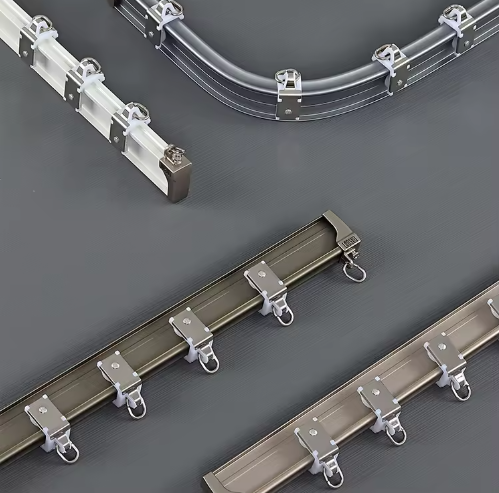
The High Cost of On-Site Labor
In almost any hotel project, labor is a more significant and unpredictable cost than materials. Every minute an installer spends searching for a part, assembling a bracket, or cutting a track to length is money wasted.
- Pre-Cut Lengths: If a hotel chain has three standard window sizes across its properties, ordering tracks pre-cut to those lengths at the factory is a game-changer. It eliminates on-site metal cutting, saving time and ensuring perfect, clean edges on every track.
- Room Kitting: Instead of shipping pallets of bulk track and boxes of 1,000 screws, ask the manufacturer to package all the components needed for one window into a single box. The installer grabs one box per room. Nothing gets lost, and they have exactly what they need, right where they need it.
Long-Term Value vs. Upfront Price
A track system that costs 10% more but is twice as durable will save you a fortune over a 10-year lifespan. Maintenance calls, replacement parts, and the cost of a room being "out of order" due to a broken curtain quickly add up. Investing in high-quality POM carriers and heavy-duty brackets from the start is one of the most effective long-term cost-reduction strategies.
What Quality Standards Should Multi-Property Hotel Chains Look For?
Your hotel chain has properties in Miami, Dubai, and Singapore. You source a curtain track system based on a general quality certification. However, the brackets on the Miami property start showing rust spots after a year due to the salty air. The plastic carriers in the Dubai property become brittle from the intense UV exposure through the large windows. The quality standard you used was too generic and didn’t account for the specific environmental stresses of each location, leading to premature failures.
Multi-property hotel chains should look for quality standards that go beyond basic ISO certification and include performance testing relevant to specific hotel environments. This includes asking for salt-spray test data for coastal properties, UV degradation testing for sun-intensive locations, and high-cycle load testing for all components. A reliable manufacturing partner should be able to provide test reports that prove their products can withstand these real-world conditions.
Environmental Performance Testing
A generic quality certificate is a starting point, not a guarantee of performance. The environment is the ultimate test.
- Salt-Spray Testing (ASTM B117): For any hotel near the coast, this is non-negotiable. This test simulates a corrosive seaside environment. Ask for reports showing how many hours the brackets and track finish can endure before showing signs of corrosion.
- UV Resistance Testing: Components inside the track, especially plastic carriers, are exposed to intense heat and UV radiation. Ask for data that shows the material won’t become brittle or discolor after prolonged exposure. This is crucial for hotels in hot, sunny climates.
Mechanical Durability Testing
This is where you separate the good from the great. It’s not about how the track looks, but how it performs under stress.
- Cycle Testing: As I’ve mentioned before, this is the most important test. A machine opens and closes a weighted curtain thousands of times to simulate years of guest use. A carrier that can survive 10,000+ cycles is built for the hotel industry.
- Load Capacity Testing: This should test the entire system, not just the track. A strong track with weak brackets is a failed system. The quality standard should specify the load capacity of the bracket, the anchor point, and the carrier.
How Do Procurement Teams Compare Factory-Direct vs. Distributor Prices?
You’re comparing prices for a large project. A local distributor’s price is $25 per unit. The factory-direct price from overseas is $18 per unit. The $7 difference seems massive, so you lean towards the factory. But you haven’t factored in international shipping costs, import duties and taxes, customs brokerage fees, and the cost of holding inventory. Suddenly, that $18 unit is costing you $24, and you’ve taken on all the risk of shipping delays and damage.
To accurately compare factory-direct vs. distributor prices, procurement teams must calculate the Total Landed Cost. This means starting with the factory’s "ex-works" price and systematically adding all other expenses: ocean or air freight, insurance, import duties, customs fees, and domestic transportation to the final destination. Only by comparing this final landed cost against the distributor’s delivered price can you make a true apples-to-apples financial decision.
Breaking Down the Landed Cost
The factory price is just the beginning. Be sure to account for:
- Freight: Ocean freight is cheaper but slow; air freight is fast but expensive. The choice impacts your project timeline and budget.
- Duties and Taxes: Every country has different import duties for specific product categories. This percentage is applied to the value of the goods and can be a significant cost.
- Brokerage and Fees: You will need a customs broker to clear your shipment, and they charge fees for their service. There are also port fees and other administrative charges.
- Inventory Costs: If you buy direct, you are buying in bulk. You need to pay for the warehouse space to store the product until it’s needed on site.
The Value of a Distributor
While a distributor’s price includes their margin, it also includes significant value. They handle all the complexities of international logistics1, customs, and warehousing. They hold the inventory, allowing you to order what you need, when you need it. For projects with tight timelines2 or complex logistics, the reliability and convenience offered by a good distributor can be worth the extra cost.
Making the Right Choice
| Sourcing Model | Pros | Cons | Best For |
|---|---|---|---|
| Factory-Direct | Lowest potential unit price, direct communication | High logistical complexity, high volume required, risk of delays | Very large, well-planned projects with an experienced in-house logistics team. |
| Distributor | Simplified process, lower risk, local support, just-in-time inventory | Higher unit price, less control over manufacturing | Projects with tight timelines, variable demand, or teams that lack import expertise. |
Conclusion
Mastering curtain track procurement for hotel chains requires a fundamental shift in perspective. It’s time to move beyond the narrow focus on the per-meter aluminum price and embrace the concept of Total Installed Cost. By specifying complete, pre-assembled systems, demanding relevant quality testing, and accurately calculating landed costs, you can transform your procurement process. This strategic approach not only slashes hidden labor expenses and accelerates project timelines but also builds a foundation of long-term durability and guest satisfaction. True savings are found not in the cheapest part, but in the smartest, most efficient system.
Frequently Asked Questions (FAQ)
1. How do I actually calculate the "Total Installed Cost" you mentioned?
The simplest formula is: (Total System Price Per Window) + (Estimated Installation Time in Hours × Installer’s Hourly Rate) = Total Installed Cost. Comparing this final number between suppliers gives you a true cost comparison, factoring in the critical labor component.
2. What exactly is "room kitting," and is there an extra charge for it?
Room kitting is when we package all the necessary components for a single window—the pre-cut track, the correct number of carriers, two end-stops, and the specific brackets—into one labeled box. While there might be a small fee, it’s almost always erased by the huge savings in on-site labor from not having to sort and count thousands of tiny parts.
3. Is ordering pre-cut tracks practical if my window sizes aren’t perfectly uniform?
Absolutely. Even if you have several different window sizes, providing a detailed "cutting list" to the manufacturer is far more efficient. We use automated saws for precision and speed, which eliminates on-site metal dust, reduces errors, and is much faster than an installer cutting each piece manually.
4. Are intensive quality tests like salt-spray or UV-resistance really necessary?
They are not just necessary; they are a form of insurance. The small upfront investment in a product proven to withstand its environment is tiny compared to the enormous cost of replacing failing tracks across 200 rooms in a coastal or sun-drenched hotel a few years down the line.
5. For a project of around 500 rooms, should I even consider a distributor?
It depends on your team’s expertise. If you have a dedicated logistics and import team, buying factory-direct can save money. However, if that’s not your core strength, a good distributor’s ability to manage shipping, customs, and warehousing provides immense value and reduces project risk.
6. What is the single most common point of failure you see in hotel track systems?
It’s almost always the carriers. Guests are not gentle. They yank curtains open and closed, putting huge stress on the small plastic wheels. This is why investing in high-cycle, durable POM carriers is the most important decision after selecting an efficient installation system.
7. How can I verify a manufacturer’s claims about their product quality and testing?
Ask for the reports. A reputable manufacturer will have no problem providing you with third-party lab results for cycle testing, load capacity, and environmental resistance. If a supplier is hesitant to share their data, it’s a major red flag.
8. Do all manufacturers offer pre-assembled brackets or room kitting services?
No, and this is a key way to differentiate suppliers. A manufacturer that offers these services understands the importance of installation efficiency. A factory that only wants to sell you bulk aluminum and bags of parts is not your partner in reducing total project costs.
9. What’s a realistic time savings per window using a pre-assembled system vs. a component-based one?
Based on feedback from installation teams, a pre-assembled, kitted system can reduce the installation time per window from over 45 minutes down to just 15-20 minutes. Scaled across hundreds of rooms, this translates to hundreds of saved labor hours.
10. How does the weight of the curtain fabric (e.g., sheers vs. blackout) affect my choice of track and carriers?
Heavier blackout and acoustic curtains require a more robust system. You should specify a heavy-duty track profile and, more importantly, increase the number of carriers per meter to distribute the weight evenly. Also, ensure the brackets are rated to handle the combined load with a significant safety margin.